
Writings: Christianity
The Dura-Europos Gospel harmony
The Dura-Europos Gospel harmony is a small piece of Greek parchment that blends the four Gospels into one account. It was found in 1933 at Dura-Europos, Syria, inside a wall embankment built just before the city fell about 256 CE. Yale's Beinecke Library holds it. Scholars disagree whether it belongs to Tatian's Diatessaron, a second-century harmony.
Last reviewed:
Three dates, kept apart
The text's date: the tradition's view
Eusebius says Tatian formed a combination of the Gospels, the Diatessaron, and in his Church History (book 4, chapter 29) gives no year for it. This fragment lay buried until 1933.
The text's date: critical scholars' view
about 172 to 180 CE if it is Tatian's Diatessaron; the late 2nd century CE if it is another harmony
This copy made
no later than 256 or 257 CE; the first half of the 3rd century on handwriting; the second part of the 2nd century or later on one view (the strip starts that view at 150 CE; its authors prefer a late 2nd-century date)
This copy found
excavated on March 5, 1933, at Dura-Europos; published 1935
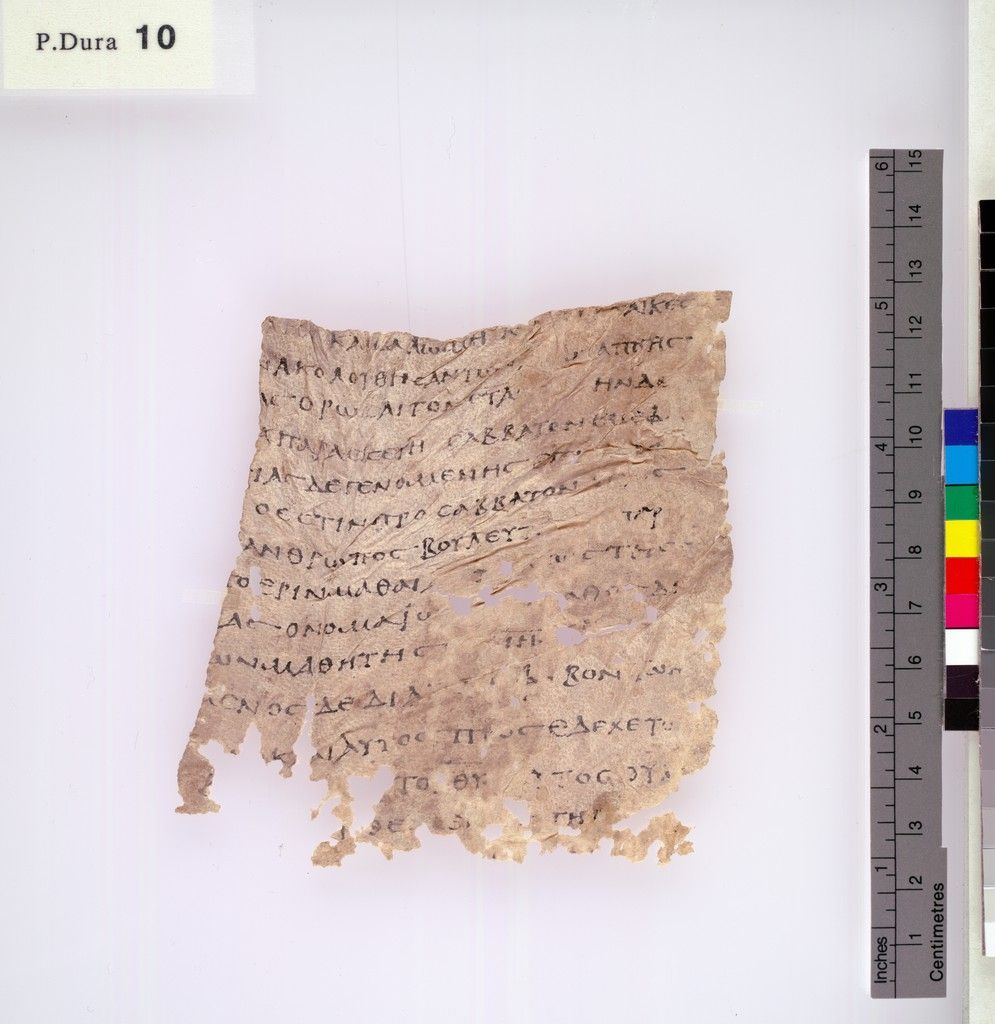
What it is
This is a small piece of parchment, about 9.5 by 10.5 centimeters, written in Greek on one side. Parchment is animal skin prepared for writing.1 Portions of fifteen lines survive, and fourteen can be read.2 It seems to come from a roll, not a bound book.23 The lines are a harmony: one account made by taking phrases from Matthew, Mark, Luke, and John. They mention the women who followed Jesus and describe Joseph of Arimathea.42 The dates above are for this copy and for the harmony's composition, not for the four Gospels it draws on.
How the copy was dated
Two methods date this copy: the layer where it lay, and its handwriting. The layer gives a last possible date. Carl Kraeling, the Yale scholar who first published it, held that the embankment was built after 254 CE and before 256 or 257 CE, when coin finds stop and the Sasanian king Shapur I is presumed to have taken the city. That is the latest the copy can be.425
Kraeling compared the handwriting with Greek hands from Egypt and judged it to belong to the first half of the third century. He kept the period back to 200 CE open.2 He thought the roll was likely used in the nearby house church, made into a Christian chapel between 222 and 235 CE.2
D. C. Parker, D. G. K. Taylor, and M. S. Goodacre (1999) hold, as the reference site Early Christian Writings quotes them, that the parchment was made between the second part of the second century and the embankment, and they prefer a late second-century date.6 Matthew Crawford (2016) reports that they doubt the link to the church, because the parchment was cut. He holds that the roll may have been used elsewhere first, and that it is unduly skeptical not to assume some connection between the only two surviving pieces of material evidence for Christianity at Dura-Europos, found two blocks apart.3 See also how ancient texts are dated.
The text: its date and authorship
The tradition's account
Catholic teaching holds that the four Gospels are of apostolic origin: the apostles preached, and they and apostolic men wrote the message down. The Orthodox Church in America's catechism names Matthew, Mark, Luke, and John as the four evangelists, the writers of the Gospels. It dates the first three to the beginning of the second half of the first century, and John near its close.789
The evangelical Chicago Statement, which speaks of scripture in general, rejects source study that leads to rejecting a book's stated authorship. The Reformed Westminster Confession lists the Gospels according to Matthew, Mark, Luke, and John among the books of scripture. The Catholic, evangelical, and Reformed statements give no year.1011
In his Church History, Eusebius, a church historian, holds that Tatian, a second-century Christian, formed a combination of the Gospels called the Diatessaron, and gives no year for it.124
The historians' view
Modern scholars, as Dale Martin of Yale explains in an Open Yale lecture, hold that the four Gospels were published without their authors' names. Mark, the earliest, was probably written about 70 CE.13
Scholars disagree on the harmony's maker. Carl Kraeling's 1935 edition holds that it belongs to Tatian's Diatessaron, which scholars of his day dated about 172 CE, and J. Joosten (2003) holds that it stands in the Diatessaron's textual tradition.214 Joan Taylor and Mina Monier (2021) date that work about 180 CE and hold that the fragment tries to copy it.15 D. C. Parker, D. G. K. Taylor, and M. S. Goodacre (1999, as Leo Depuydt reports) hold that it is not part of the Diatessaron, but a harmony composed probably in the later second century.146
How it was found
Excavators from Yale University and the French Academy of Inscriptions and Letters, led by Clark Hopkins, found the fragment on March 5, 1933, at Dura-Europos.25 It lay beside the western city wall near Tower 18, inside the earth embankment the Roman garrison had built for a siege.216
The spot was about 150 meters from the Christian house church, torn down to make way for the embankment.2 The fragment lay buried until 1933.2 Kraeling published it in 1935, and it is now at the Beinecke Library at Yale.217
What it shows, and what it does not
It shows that a Greek text blending the four Gospels was written out, and lay in a Roman frontier city, before about 256 CE.3214 The layer fixes that last date, so the copy does not rest on handwriting alone.2 It also adds a witness from Dura-Europos, in modern Syria, though much early manuscript evidence comes from Egypt.53
It does not show who made the harmony, or whether it is part of Tatian's Diatessaron, since scholars who have studied the wording disagree. It does not show where the roll was written, because the layer fixes only where it ended up, or whether the nearby church owned it.23
Read next
Sources
- Hill Museum and Manuscript Library. Lexicon: Parchment (HMML School). Hill Museum and Manuscript Library, Saint John's University, entry. Accessed 2026-11-05.
- Carl H. Kraeling. A Greek Fragment of Tatian's Diatessaron from Dura, edited with facsimile, transcription and introduction (Studies and Documents 3). Christophers, London, 1935, Section I, Discovery, Description, Provenance and Date, pp. 3 to 8; section III, p. 11; section V, p. 19. Accessed 2026-11-05.
- Matthew R. Crawford. The Diatessaron, Canonical or Non-canonical? Rereading the Dura Fragment. New Testament Studies 62.2 (April 2016), Cambridge University Press, 2016, pp. 253 to 277; abstract and notes 3, 8, 12, and 14. Accessed 2026-11-05.
- F. C. Burkitt. The Dura Fragment of Tatian. Journal of Theological Studies 36 (1935), 1935, pp. 255 to 259. Accessed 2026-11-05.
- Yale University Art Gallery. Dura-Europos: Excavating Antiquity, historical background. Yale University Art Gallery, Historical Background. Accessed 2026-11-05.
- Peter Kirby. The Dura-Europos Gospel Harmony. Early Christian Writings, record. Accessed 2026-11-05.
- Second Vatican Council. Dei Verbum, Dogmatic Constitution on Divine Revelation. Holy See, 1965, sections 9, 10, 11, 18, 19, and 22. Accessed 2026-10-28.
- Thomas Hopko. The Orthodox Faith, Volume I: Doctrine and Scripture, Sources of Christian Doctrine: Bible. Orthodox Church in America. Accessed 2026-10-28.
- Thomas Hopko. The Orthodox Faith, Volume I: Doctrine and Scripture, New Testament: Gospels. Orthodox Church in America, opening sections and the sections on Luke and John. Accessed 2026-11-05.
- International Council on Biblical Inerrancy. The Chicago Statement on Biblical Inerrancy. Alliance of Confessing Evangelicals, summary statement, Articles XII and XVIII. Accessed 2026-10-28.
- Westminster Assembly. The Westminster Confession of Faith. The Orthodox Presbyterian Church, chapter 1. Accessed 2026-10-28.
- Eusebius of Caesarea. Church History, book 4, chapter 29, The Heresy of Tatian (Nicene and Post-Nicene Fathers, second series, volume 1, translated by Arthur Cushman McGiffert). New Advent, 1890, book 4, chapter 29, section 6. Accessed 2026-11-05.
- Dale B. Martin. Introduction to New Testament History and Literature (RLST 152), Lecture 2: From Stories to Canon. Open Yale Courses, Yale University, transcript. Accessed 2026-10-28.
- Leo Depuydt. Classical Syriac Manuscripts at Yale University: A Checklist. Hugoye: Journal of Syriac Studies 9.2 (2006), Beth Mardutho, 2006, paragraph 4. Accessed 2026-11-05.
- Joan Elizabeth Taylor and Mina Monier. Tatian's Diatessaron: The Arabic Version, the Dura Europos Fragment, and the Women Witnesses. Journal of Theological Studies 72 (2021), Oxford University Press, 2021, pp. 192 to 230, abstract (DOI 10.1093/jts/flab039). Accessed 2026-11-05.
- C. Bradford Welles, Robert O. Fink, and J. Frank Gilliam. The Excavations at Dura-Europos, Final Report V, Part I: The Parchments and Papyri, entry 10, Tatian, Diatessaron. Yale University Press, 1959, pp. 73 to 75, with the handwriting discussion earlier in the volume. Accessed 2026-11-05.
- Center for the Study of New Testament Manuscripts. Manuscript GA 0212 (P. Dura 10). CSNTM, record. Accessed 2026-11-05.