
Writings: Christianity
The Didache Codex
The Didache codex is a Greek parchment book finished on June 11, 1056 CE by a scribe named Leon. It holds the only complete Greek text of the Didache, an early manual of church life, with other early Christian writings. Philotheos Bryennios found it in Constantinople in 1873; it is now in Jerusalem.
Last reviewed:
Three dates, kept apart
The text's date: the tradition's view
No church teaching on the Didache's date or writer appears in the sources consulted. Its titles in this codex present it as the teaching of the Twelve Apostles.
The text's date: critical scholars' view
about 100 to 120 CE in a 2007 reference work, and around 100 CE or a little after in Dale Martin's lecture; other proposals run from 50 to 70 CE (Jean-Paul Audet, as Stephen Patterson reports) to 160 to 190 CE (Hilgenfeld, in the survey Riddle printed after 1885)
This copy made
June 11, 1056 CE, as the scribe's closing note gives it
This copy found
found by Philotheos Bryennios in Constantinople in 1873; the Didache published in 1883
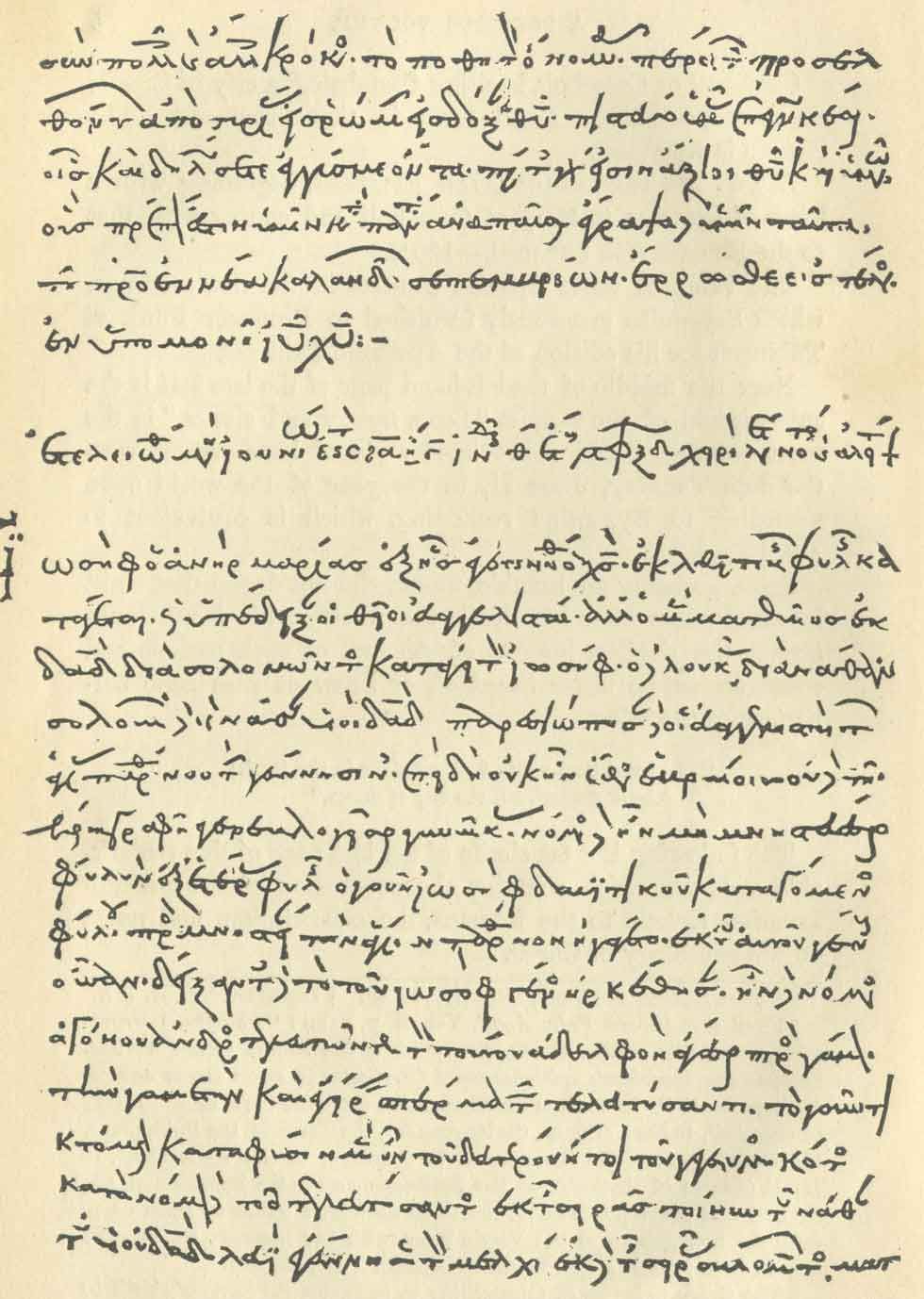
What it is
The Didache codex is a Greek book of 120 parchment leaves, bound as a codex, a book of pages rather than a roll.12 It gathers Christian writings: a Bible summary attributed to John Chrysostom, the Epistle of Barnabas, 1 and 2 Clement, the Didache, the letters of Ignatius, and other items.1 The Didache, Greek for teaching, is a short manual of church life.34 It covers right conduct, baptism, fasting, prayer, the Eucharist (also called communion or the Lord's Supper), visiting teachers, church officers, and the end of the age.54
The complete Greek text survives only in this codex. A few verses survive on a fourth-century parchment fragment, and parts survive in Coptic and Ethiopic translations.5
How the copy was dated
The codex dates itself. At its end, the scribe records the day, June 11, in the year 6564 by the calendar used in Constantinople. He signs himself Leon, a notary and sinner. That calendar counts from a creation set 5508 years before the birth of Jesus, so 6564 converts to 1056 CE.6 A note like this, written by the copyist at the end of a book, is called a colophon.
A 2007 reference work gives the same date, June 11, 1056 CE, and the French catalog Pinakes lists Leon as active in 1056.51 M. B. Riddle, writing after 1885, saw no reason to doubt the codex's age, and none of the sources consulted disputes the date.2 The script is minuscule, a small joined-up hand, and the reference work places the copying in Palestine, possibly Caesarea.15 Other methods are described in how ancient texts are dated.
The text: its date and authorship
The tradition's account
Some church writers treated the Didache as a work outside the New Testament. Eusebius of Caesarea lists the so-called Teachings of the Apostles among the books he called spurious, a group he sets after the books of scripture.42 Athanasius, in his letter of 367 CE, holds that it is not in the canon but was appointed by the Fathers to be read by new converts.7 The codex's titles present the work as the teaching of the Twelve Apostles, and parts of it were translated into Coptic and Ethiopic.45 No church teaching on its date or writer appears in the sources consulted.
The historians' view
Dale Martin of Yale holds that the Didache presents itself as the teaching of the twelve apostles but was not written by them, and that most people place it around 100 CE or a little after.3 A 2007 handbook, the Neue Pauly, holds that it was compiled anonymously about 100 to 120 CE, and reads the codex's titles as meant to give it the apostles' authority.5
Jean-Paul Audet dated it as early as 50 to 70 CE, Stephen Patterson reports.8 The Catholic Encyclopedia of 1908 put it between about 65 and 80 CE, reading its simple rites and offices as early signs.4 When Riddle wrote, after 1885, proposals ran from 80 to 190 CE.2
How it was found
In 1873, Philotheos Bryennios, head master of a Greek school in Constantinople, found the codex in the library of that city's Jerusalem Monastery of the Most Holy Sepulchre.2 He published the two letters of Clement from it in 1875 and the Didache in 1883.24 Since 1887 it has been in the library of the Greek Orthodox Patriarchate in Jerusalem.5
Photographs of some pages were published in 1885, and an edition with facsimile pages followed in 1887; the digitized link above is a scan of that edition.29 No source consulted says where the codex was before 1873, or when or why it came to Constantinople.
What it shows, and what it does not
The codex shows that a scribe named Leon, who signs himself a notary, copied the Didache in 1056 CE together with Barnabas, Clement, and Ignatius, and it preserves the only complete Greek text.156 Other evidence shows the work was known in Greek much earlier. That evidence includes a fourth-century fragment, the fourth-century Apostolic Constitutions, a collection of church rules whose compiler used the Didache as a source, and the notices by Eusebius and Athanasius.547
It does not show which proposed date for the Didache is right. The codex was made about 936 to 956 years after 100 to 120 CE, and about 866 to 976 years after the 80 to 190 CE range in Riddle's survey of proposals (figures computed from 1056 CE).2 It does not show who wrote the work, or whether its text changed between its composition and 1056, since only a few verses survive from any earlier Greek copy.5
Read next
Sources
- Jerusalem, Patriarchal Library, Panagiou Taphou 54. Pinakes, Institut de recherche et d'histoire des textes (CNRS). Accessed 2026-11-05.
- M. B. Riddle. Introductory Notice to the Teaching of the Twelve Apostles. Early Christian Writings, sections 1 and 2. Accessed 2026-11-05.
- Dale B. Martin. Introduction to the New Testament History and Literature (RLST 152), Lecture 25: Ecclesiastical Institutions: Unity, Martyrs, and Bishops. Open Yale Courses, Yale University, transcript, chapter 5 (The Didache and the Development of Liturgy). Accessed 2026-11-05.
- John Chapman. Didache. The Catholic Encyclopedia, vol. 4 (Robert Appleton Company), on New Advent, 1908. Accessed 2026-11-05.
- Ferdinand R. Prostmeier. Didache. Der Neue Pauly, Supplement 2: Geschichte der antiken Texte (Stuttgart: Metzler), 2007, pages 199 to 200. Accessed 2026-11-05.
- Philip Schaff. The Oldest Church Manual Called The Teaching of the Twelve Apostles. Charles Scribner's Sons, New York, 1885, pages 6 to 7 (the closing note of the codex, in translation, and a note on the Greek calendar). Accessed 2026-11-05.
- Athanasius of Alexandria. Letter 39 (Festal Letter for 367). New Advent (from Nicene and Post-Nicene Fathers, Second Series, Vol. 4), 367, sections 4 to 7. Accessed 2026-10-28.
- Peter Kirby (editor). Didache. Early Christian Writings, the section "Information on Didache". Accessed 2026-11-05.
- J. Rendel Harris. The Teaching of the Apostles, newly edited with facsimile text and a commentary, from the MS of the Holy Sepulchre. Clay, London, 1887. Accessed 2026-11-05.