
Writings: Buddhism
Tripitaka Koreana
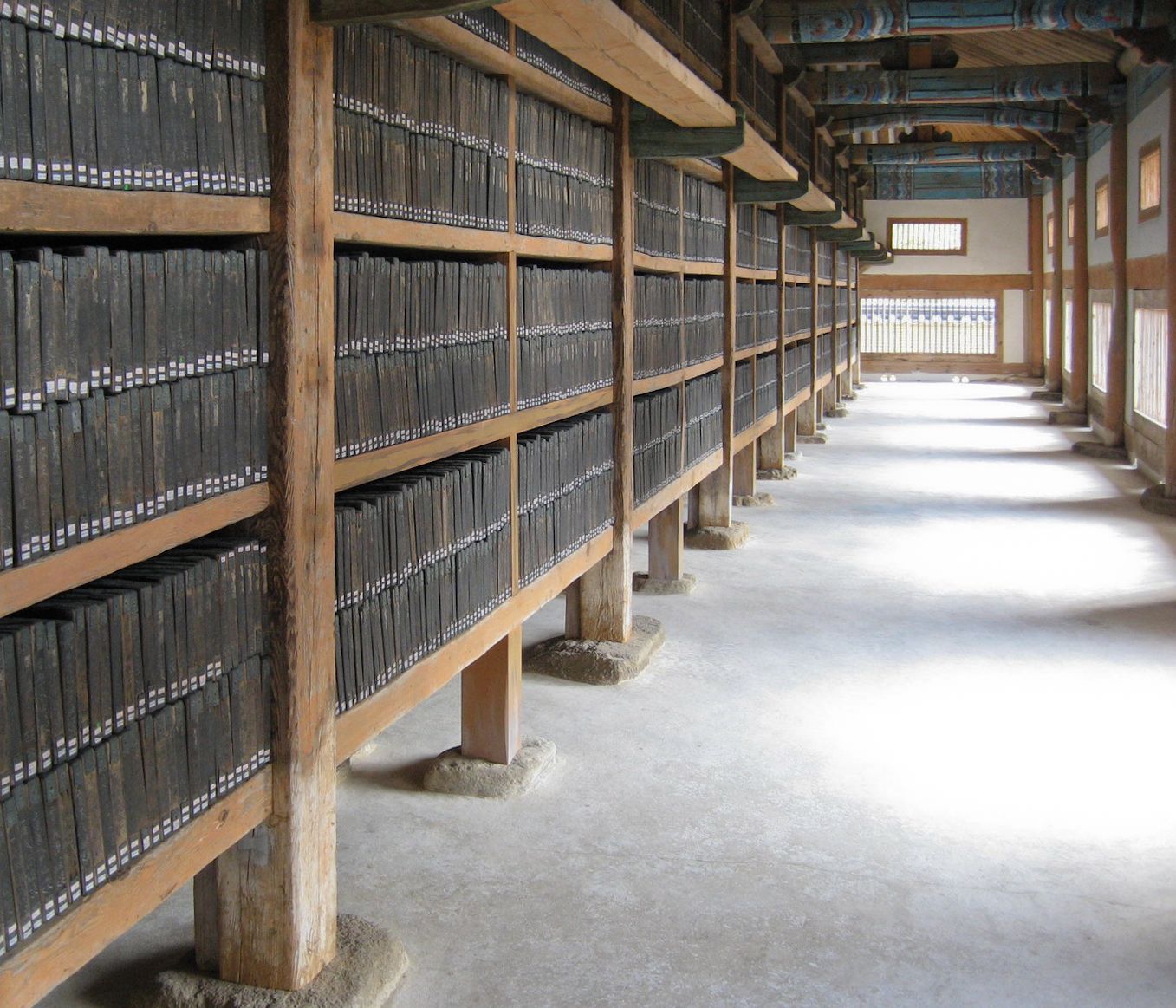
The Tripitaka Koreana is the Buddhist canon in classical Chinese, carved on 81,258 wooden printing blocks in Korea in the 13th century, by the count in Korea's 2006 nomination to UNESCO. Sources date the carving to 1237 to 1248, or the whole project to 1236 to 1251. The blocks have been kept at Haeinsa Monastery since about 1398.
Last reviewed:
Three dates, kept apart
The text's date: the tradition's view
The canon gathers many texts, so no single year applies, and the sources used give none for the collection.
The text's date: critical scholars' view
The canon gathers texts translated over more than a thousand years, so no single year applies.
This copy made
1237 to 1248 for the carving (UNESCO World Heritage listing); the whole project ran 1236 to 1251 (Korea's Memory of the World nomination, and Lewis Lancaster)
This copy found
Never lost: held by Haeinsa Monastery since about 1398, after the carving and a first storage on Ganghwa Island
What it is
The Tripitaka Koreana, called the Goryeo Daejanggyeong in Korean, is the Buddhist canon in classical Chinese, carved on 81,258 wooden printing blocks. A printing block is a slab carved so that it can be inked and pressed onto paper. The word Tripitaka comes from Sanskrit and means three baskets, a name for a canon of scriptures.1
Korea's 2006 nomination to UNESCO's Memory of the World Register counts 1,514 texts in 6,815 fascicles (sections of a text), in about 52 million characters. Each block measures 24.2 by 69.7 centimeters and carries 23 lines of 14 characters on each side. The texts were collected from Buddhist materials translated from Indian and Central Asian languages, along with a limited selection of works written in Chinese.2
How the copy was dated
Korea's nomination, made by its Cultural Heritage Administration, says each block carries a production record in its margin. The record gives the year and place of carving, the carver's name, and the name of any donor.2 The sources consulted name no other dating method.
UNESCO's World Heritage listing says the blocks were engraved between 1237 and 1248.3 The nomination says a supervising office was formed on Ganghwa Island in 1236 and the work was completed in 1251, and it gives 1237 to 1248 for the carving. Lewis Lancaster, in the Encyclopedia of Religion, gives 1236 to 1251 for creating the second set.24 No source says outright why the spans differ, but the nomination ties 1236 to forming the supervising office and 1251 to the finish of the work. For the methods, see how ancient texts are dated.
The text: its date and authorship
The blocks carry the Chinese canon, so both views concern its many texts as a group.2
Korea's nomination and the Tiantai school
Korea's nomination of the canon to UNESCO's Memory of the World Register, a heritage document of Korea's Cultural Heritage Administration, states that the teachings were passed on by word of mouth and first put in writing 200 years after the Buddha's death. It states that they were translated into Chinese in the first century CE.2 Theravada tradition places the first writing down in the first century BCE, so the two dates differ.4 The Tiantai school, in a classification begun by Chih-i, holds that the Buddha taught his sutras in five periods of his life, with the Avatamsaka (Flower Garland) Sutra first. The Concise Oxford Dictionary of World Religions, which describes this scheme, gives no calendar year.5 The nomination records that Haeinsa, the blocks' owner, requested it. The sources used here include no separate statement on dating from Haeinsa or a Korean Buddhist order.2
The historians' view
Paul Harrison, in the Encyclopedia of Buddhism, holds that the Chinese canon includes translations of texts from several Indian schools. It also includes Mahayana sutras produced in India from about the first century CE onward.6 Lewis Lancaster holds that Chinese translators worked for more than a thousand years, some from as early as the second century CE.4 Oskar von Hinuber holds that early Buddhist literature was composed during a period of pure orality in India.7 Bhikkhu Sujato and Bhikkhu Brahmali, authors who argue a single thesis in a book-length work, write that most academic scholars of early Buddhism cautiously affirm that the early texts may contain some authentic sayings of the Buddha. They argue that the bulk of the sayings were very likely spoken by him.8
How it was found
It was not found, because it was never lost. According to the nomination, an earlier Goryeo set of blocks, begun in 1011, was destroyed in the Mongol invasion of 1234. The second set was carved in the hope of spreading the Buddha's teaching and of drawing on his protective power against natural disasters and foreign invasion.2
The finished blocks were first kept on Ganghwa Island. In 1398 they went by ship up the Han River to Jicheonsa Monastery near Seoul and, in the fall of that year, to Haeinsa for permanent storage.2
Han Sang-gil writes that when and how they reached Haeinsa had remained a mystery. He agrees with Han Yong-un and Kim Young-soo that they left Ganghwa Island by May 1398 and arrived by January 1399. He also reports a dispute over where the blocks were carved. Some argue that all the carving was done at Haeinsa and nearby, while Han finds the evidence supports Ganghwa Island.9 The nomination says the Tripitaka Koreana Research Institute digitized the text in 2000; its web address could not be confirmed here.2
What it shows, and what it does not
It shows that a Chinese-language canon of 1,514 texts was assembled, checked against earlier editions, and carved in Korea in the 13th century. The nomination says the monk Sugi, who prepared the text, compared the first Goryeo set with the Chinese Northern Song and Khitan editions. It adds that he recorded his corrections in a 30-fascicle record written in 1247. Lancaster describes his method in similar terms.24
It does not show when the texts it carries were composed or what the Indian originals said, because the blocks record a 13th-century edition of older translations. Lancaster holds that translation went on for over a thousand years, some as early as the second century CE. The nomination places the start of Chinese translation in the first century CE, a century earlier than the second-century translations Lancaster names. The blocks also do not settle which sutras the Buddha taught, a question on which the accounts above differ.426
Read next
Sources
- UNESCO Memory of the World. Printing woodblocks of the Tripitaka Koreana and miscellaneous Buddhist scriptures. UNESCO. Accessed 2026-10-28.
- Cultural Heritage Administration of the Republic of Korea (nominator). Memory of the World Register, Ref N. 2006-47: Printing woodblocks of the Tripitaka Koreana and miscellaneous Buddhist scriptures. UNESCO Memory of the World Programme, Part A, sections 1, 3.2, 4.1, 4.2, 4.3, 5; pp. 1 to 9. Accessed 2026-11-05.
- UNESCO World Heritage Centre. Haeinsa Temple Janggyeong Panjeon, the Depositories for the Tripitaka Koreana Woodblocks (World Heritage List, no. 737). UNESCO, Brief synthesis; Protection and management requirements. Accessed 2026-11-05.
- Lewis R. Lancaster. Buddhist Books and Texts: Canon and Canonization. Encyclopedia of Religion, 2nd ed. (Macmillan Reference USA), via Encyclopedia.com, 2005. Accessed 2026-10-28.
- The Concise Oxford Dictionary of World Religions. Five Periods and Eight Schools. Oxford University Press, via Encyclopedia.com, entry. Accessed 2026-11-05.
- Paul Harrison. Canon. Encyclopedia of Buddhism (Macmillan Reference USA), via Encyclopedia.com, 2004. Accessed 2026-10-28.
- Oskar von Hinuber. Pali, Buddhist Literature in. Encyclopedia of Buddhism (Macmillan Reference USA), via Encyclopedia.com, 2004. Accessed 2026-10-28.
- Bhikkhu Sujato and Bhikkhu Brahmali. The Authenticity of the Early Buddhist Texts. Oxford Centre for Buddhist Studies (supplement to Journal of the Oxford Centre for Buddhist Studies, vol. 5), 2014, abstract; sections 3.6 and 3.7. Accessed 2026-10-28.
- Han Sang-gil. The Timeline of How the Tripitaka Koreana Was Brought To Haeinsa Temple. Korean Journal of Buddhist Studies 30 (2011), Korean Association of Buddhist Studies, 2011, pp. 139 to 174; English abstract. Accessed 2026-11-05.