
Writings: Buddhism
The Library of Congress Gandharan scroll
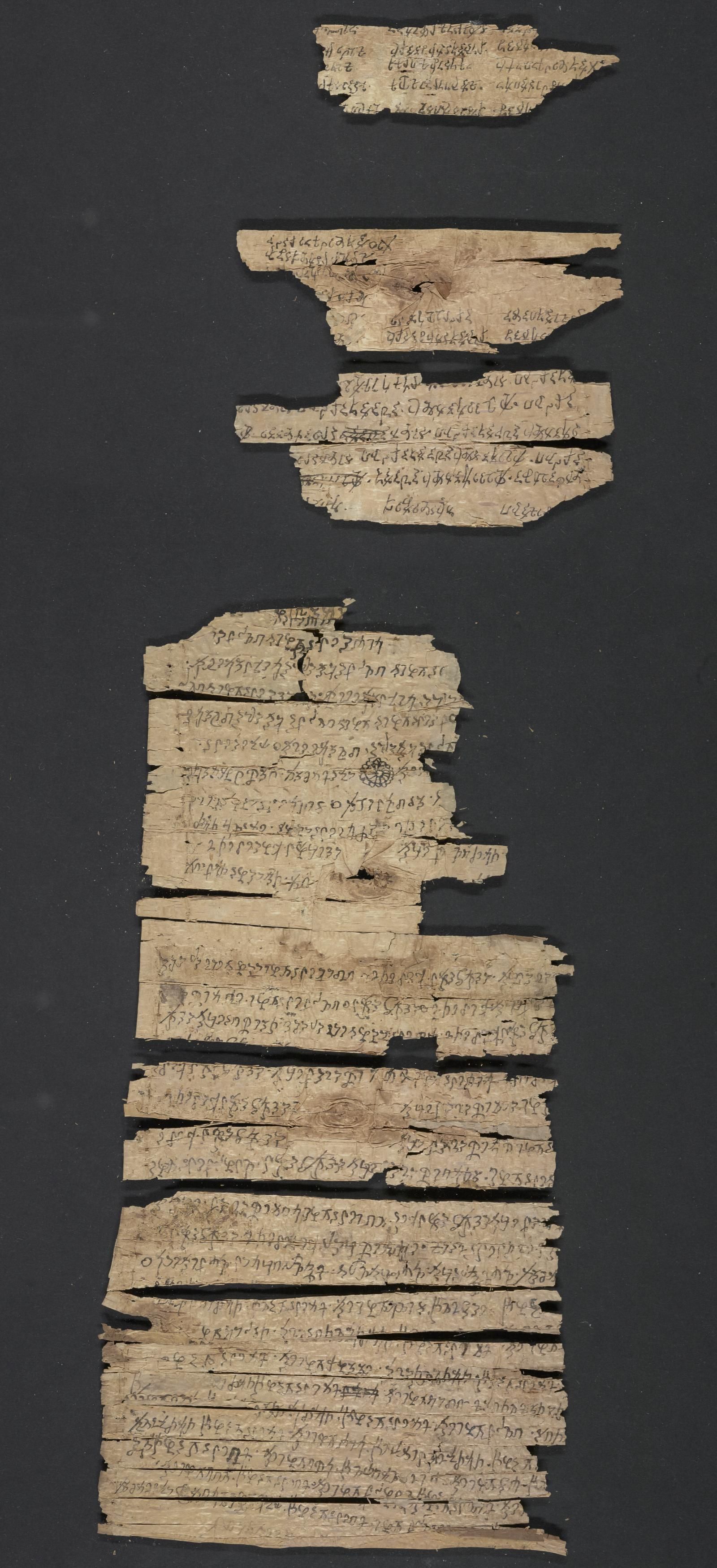
The Library of Congress holds one Gandhari birch-bark scroll, told in the Buddha's voice, about earlier buddhas and the future buddha Maitreya. Radiocarbon dating places it between the first century BCE and the first century CE. The Library bought it from a private collector, no findspot is recorded, and its images are online.
Last reviewed:
Three dates, kept apart
The text's date: the tradition's view
No statement consulted, from any branch, gives a date for this text.
The text's date: critical scholars' view
The sources used give no date for the text's composition, and this one copy gives only a latest date.
This copy made
between the first century BCE and the first century CE by radiocarbon (Library of Congress; the bar runs from 100 BCE to 100 CE); Stefan Baums's table lists the first century CE, with a question mark; Holly Krueger's 2008 conservation paper remarks that the scroll was dated a bit earlier than most of the related material (which she places in the first century BCE), with no figures, and the bar does not show this
This copy found
the Library says it came from a group of materials unearthed in Gandhara in the 1990s, with no findspot recorded; bought from a private collector, in 2003 by the Library's catalog and blog or in 2005 by its conservator's paper
What it is
This is a single scroll, a long strip of birch bark made to be rolled up. It is written in Gandhari, an Indian language related to Sanskrit, in the Kharosthi script.1 It survives in six large fragments and about 130 smaller ones. The beginning and end are lost, but about 75 to 80 percent of the text remains.23
The text is told in the Buddha's voice: short biographies of earlier buddhas, his own birth and awakening, and a prediction of the future buddha Maitreya. The Library's catalog counts fifteen buddhas.2 A Library blog post reports that Richard Salomon identifies it as likely the Bahubuddha Sutra, or Many Buddhas Sutra. It resembles a Sanskrit text of that name in the Mahavastu, a biography of the Buddha and his past lives.4
How the copy was dated
The Library gives the date as a radiocarbon result: between the first century BCE and the first century CE.32 Radiocarbon dating measures the carbon-14 left in once-living material, here birch bark, and gives a range of years, not one year.56 The Library's pages do not name the laboratory or give the calibration or the probability, so the pages read give no way to check the range against a published report. Library staff add that the scroll is possibly as old as the first century BCE.34
Baums lists the scroll as the first century CE, with a question mark, in a 2014 table of Gandharan scrolls. He cites handwriting, language, and radiocarbon for the Gandharan scrolls as a group, which he dates to the first and second centuries CE. He adds that some may be as old as the first century BCE.1 A 2008 paper by the Library's paper conservator, Holly Krueger, remarks in passing that carbon-14 results place most of the related material in the first century BCE. It adds that this scroll was dated somewhat earlier, and gives no figures; it is a conservation paper, not a dating report.7 See how ancient texts are dated.
The text: its date and authorship
The Theravada tradition's account
The Theravada tradition, the branch of Buddhism followed in Sri Lanka and Southeast Asia, teaches that the Buddha spoke of earlier buddhas. In the Pali canon's Great Discourse on Traces Left Behind, he names six earlier buddhas and gives each one's clan, social class, and lifespan.89 It teaches that he taught for 45 years, until his death in 544 BCE by its reckoning, and that five hundred monks recited his discourses soon after.10 This scroll is also told in the Buddha's voice and gives each buddha's lifespan.4 The sources used here for the Theravada account do not discuss it, and no statement about it from Mahayana or Vajrayana was found.
Library staff and scholars
Salomon identifies the scroll as likely the Bahubuddha Sutra, because it resembles a Sanskrit text of that name in the Mahavastu, as the Library's blog reports. Library staff hold that this early copy adds clarity to how the idea of many buddhas developed, and note that the lifespans shrink across the scroll, from billions of years to the 80 years of the Buddha.4 Baums counts two scribes.1 Salomon discusses the scroll in a 2018 lecture and a 2018 book of Gandharan texts in translation. It has no colophon, a note at the end naming the text or its copyist, so the names of both are unknown.4
How it was found
The sources used record no findspot for the scroll, and Baums lists its provenience, or place of origin, as unknown.1 The Library says that a group of materials buried high in the arid mountains of Gandhara was unearthed there in the 1990s, and that it acquired this scroll from that collection. Gandhara is now the northern border area of Afghanistan and Pakistan.3 A reply on the Library's blog says it was purchased from a private collector.4 The Library's catalog and blog give 2003 for the acquisition, but a 2008 paper by its paper conservator says the Library bought the scroll in 2005.237
The scroll arrived folded in a pen box, with a handwritten note warning that it was extremely fragile. A British Library conservator, whose library had unrolled about thirty related scrolls, helped the Library unroll it, and the pieces were sealed between sheets of glass. The Library digitized the scroll in January 2019 and put it online.34
What it shows, and what it does not
It shows that a text on earlier and future buddhas, told in the Buddha's voice, was copied in Gandhari on birch bark in the first century BCE or the first century CE, on the Library's radiocarbon range. The Library's catalog counts fifteen buddhas in it.2 It is also unusually complete: about 75 to 80 percent of the text remains, better than the average Gandharan scroll, experts say.3
It does not show who composed the text: the scroll lacks a title and a colophon, its beginning and end are lost, and the sources used name no writer. Nor does it show how the text relates to any one school's canon, or where the scroll was found or what lay with it. Its date is a radiocarbon range, and Baums gives the first century CE, with a question mark, in his table.341
Read next
Sources
- Stefan Baums. Gandharan Scrolls: Rediscovering an Ancient Manuscript Type. In Manuscript Cultures: Mapping the Field, edited by Jorg B. Quenzer, Dmitry Bondarev, and Jan-Ulrich Sobisch (De Gruyter), 2014, pp. 183 to 225 (section 1, section 2, Table 1, Table 2). Accessed 2026-11-05.
- Library of Congress, Asian Division. Gandhara scroll (catalog record). Library of Congress, catalog record, LCCN 2018305008. Accessed 2026-11-05.
- Library of Congress. The Gandhara Buddha Scroll: A Delicate Treasure. Library of Congress Blog, 2019, blog post, November 2019. Accessed 2026-11-05.
- Jonathan Loar (Library of Congress, Asian Division). 2,000-Year-Old Buddhist Scroll from Ancient Gandhara Digitized by Library of Congress. 4 Corners of the World, Library of Congress blog, 2019, blog post, July 2019, and a reply in its comments. Accessed 2026-11-05.
- Radiocarbon Laboratory, Nuclear Physics Institute of the Czech Academy of Sciences. Principle of 14C dating. Nuclear Physics Institute of the Czech Academy of Sciences. Accessed 2026-11-05.
- Radiocarbon Laboratory, Nuclear Physics Institute of the Czech Academy of Sciences. Calibration (Principle of 14C dating). Nuclear Physics Institute of the Czech Academy of Sciences. Accessed 2026-11-05.
- Holly H. Krueger. Conservation of the Library of Congress' Gandhara Scroll: A Collaborative Process. The Book and Paper Group Annual 27 (American Institute for Conservation), 2008, pp. 29 and 30 (background). Accessed 2026-11-05.
- Paul Harrison. Canon. Encyclopedia of Buddhism (Macmillan Reference USA), via Encyclopedia.com, 2004. Accessed 2026-10-28.
- Bhikkhu Sujato. Translations of the early Buddhist discourses. SuttaCentral, 2026. Accessed 2026-10-28.
- John T. Bullitt. Theravada Buddhism: A Chronology. Access to Insight, 2005. Accessed 2026-10-28.