
Writings: Latter-day Saints
The 1830 first edition of the Book of Mormon
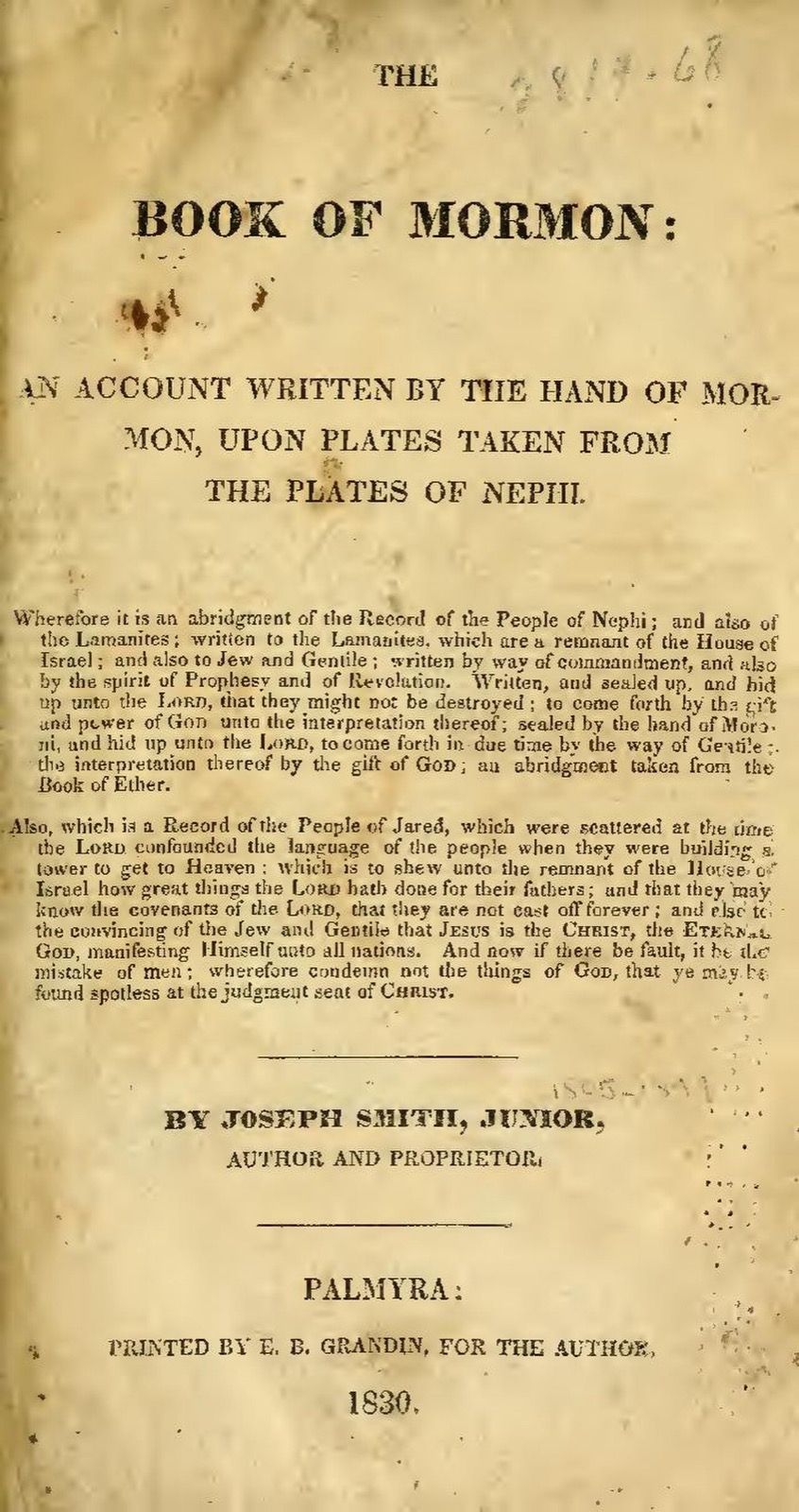
The first edition of the Book of Mormon was printed by E. B. Grandin in Palmyra, New York, and went on sale on March 26, 1830. The Church History Library gives a print run of 5,000 and estimates that around 700 copies survive, and Georgetown University's library says fewer than 500. Joseph Smith revised the text in 1837.
Last reviewed:
Three dates, kept apart
The text's date: the tradition's view
about 600 BCE, the church's date for one group's departure from Jerusalem, to about 421 CE, the church's date for Moroni, the last Nephite prophet in the Book of Mormon (neither date marks when a prophet wrote: the church's Introduction to the Book of Mormon says another group came much earlier and gives no year, and the sources used date neither the writing nor the abridgment within the span; the translation into English, mostly April to June 1829 in the church's account, is a second event that this bar does not draw and that the critical row marks)
The text's date: critical scholars' view
April 7 to the first week of July 1829, Joseph Smith and Oliver Cowdery's work on the Book of Mormon manuscript, which Fawn Brodie dates and holds Joseph Smith produced (she adds that Martin Harris may have taken dictation for as much as four months before Cowdery, which this bar does not draw; Dan Vogel, as Kyle Walker reports, also holds that Smith produced the text and dates a 'Book of Mormon Project' to 1828 to 1830 and Smith's rehearsal of the stories to 1823 on; the bar draws 1829 only, the year of Brodie's dates; Klaus Hansen reports that modern scholars concluded Smith was the author, and Brent Metcalfe's essay describes critical method without dating the text, so neither gives a date here)
This copy made
March 1830, the first printing of the Book of Mormon, on sale from 26 March 1830 (printing began in August 1829; the dates are those of the Church History Library and the Joseph Smith Papers editors, both of The Church of Jesus Christ of Latter-day Saints, and of the Church News and PBS's timeline; the sources used report no physical test and no dispute over the date)
This copy found
Not a find: the edition was sold from 26 March 1830, so no discovery applies. The sources used trace one copy's later path, Georgetown's, which passed through Jesuit schools in New York before it reached the library of Woodstock College.
What it is
The 1830 edition is the first printing of the Book of Mormon, in English. E. B. Grandin printed 5,000 copies in Palmyra, New York, in calf-leather bindings, at a cost of $3,000, the Church History Library of The Church of Jesus Christ of Latter-day Saints says.1 The library says Martin Harris, an early supporter of Joseph Smith, paid by selling part of his farm. The Joseph Smith Papers editors, who are employed by the church, write that he mortgaged the farm on 25 August 1829.123
The Church News gives a first price of $1.75 a copy, later cut to $1.25, without tying it to a source. PBS's timeline reports Harris selling copies for $1.25 within days of the sale opening.45
How the copy was dated
The year 1830 appears in the Internet Archive's record of a surviving copy, which gives the imprint as Palmyra, printed by E. B. Grandin for the author.6 The Joseph Smith Papers editors put the end of printing in mid-March 1830 and the first sale in Palmyra on 26 March 1830. The Church News and PBS give the same sale date.2745
Of the sources used, only PBS's timeline, which credits a 1979 chronology by J. Christopher Conkling, names the Wayne Sentinel, a newspaper Grandin printed, as announcing the sale.58 The library says printing began in August 1829, and the editors say typesetting is unlikely to have begun before Harris's agreement of 25 August.12 The sources used report no dispute over the date. For the methods, see how ancient texts are dated.
The text: its date and authorship
The strip's two bars are the same as in the entries on the printer's manuscript and the original manuscript. They show the church's span from one group's departure from Jerusalem to Moroni, and the 1829 work that Brodie dates.9108
The tradition's view
This column gives the church's Introduction to the Book of Mormon and its Gospel Topics essay, then Terryl Givens, a University of Richmond professor of literature and religion. The church teaches that many ancient prophets wrote the book on gold plates and that a prophet-historian abridged their words. It teaches that Joseph Smith translated it by the gift and power of God
11, as the essay says his preface to the 1830 edition put it.911 The essay adds that, apart from punctuation, formatting, typesetting, and minor corrections of copying and scribal errors, the dictated copy became the text of this edition.11
Givens says in a PBS interview published in 2007 that the book has elaborate literary structures. He says few people in Smith's time, and in his view not Smith, would have known them. He also expects the evidence never to settle the question either way.12
Scholars of the Book of Mormon's origins: Hansen, Brodie, Metcalfe, and, at second hand, Vogel
Klaus Hansen writes, in an undated encyclopedia entry, that controversy over the book's authorship began almost from the day it was published. He reports Alexander Campbell's charge that it was a figment of Smith's imagination, which Fawn Brodie supported in 1945, and says modern scholars concluded Smith was the author.13 Brodie wrote that the dictation's speed was evidence of Smith's ability.8
Kyle Walker writes in BYU Studies, a journal of Brigham Young University, which the church founded, supports, and guides. He reports that Dan Vogel, in a psychobiography of Smith, holds that Smith rehearsed the stories from 1823 and dictated them from memory.141516 A Sunstone session description calls Vogel's biography naturalistic, with a close reading of the book as reflecting Smith's life and concerns.17 Brent Metcalfe writes in Dialogue, an independent journal, that critical scholars find ultimate authority not so much in statements made by and for scripture as in the text's broad historical and literary framework.1819
Brodie and Givens each argue one thesis in the works cited here. Hansen and Walker report others' views at second hand, and the sources used include none of Vogel's own writing.
How it was found
A printed edition is not found; the question is where its copies are. The Church History Library's exhibit page, which has no date, estimates that around 700 copies of the first edition remain, without saying how it reached the figure.1 Georgetown University Library says there are fewer than 500, also without a stated basis.20 The two figures differ by more than 200 copies (computed here), and the sources used do not reconcile them.
The sources name three copies. One was on display in the church's Foundations of Faith exhibit in Salt Lake City in 2014.4 One is at Georgetown's Woodstock Theological Library. Its undated blog post says it came from Jesuit schools in Troy and Shrub Oak, New York, and has been digitized.20 A third, from the University of Pittsburgh Library System, is scanned on the Internet Archive.6 The Church News reports scans of the 1830, 1837, 1840, and 1841 editions on the Joseph Smith Papers website.21
What it shows, and what it does not
It shows the text as first published, set mostly from the printer's manuscript. One stretch, from that manuscript's sixteenth gathering of folded leaves until its twentieth, was set from the original manuscript instead. The typesetter added punctuation.2 The title page names Joseph Smith as author and proprietor
22. BYU Studies says he used the words only to secure a copyright, and Brodie writes that they may merely have followed the copyright form
8.22
Later editions revised the text. Smith and Oliver Cowdery, his scribe, marked the printer's manuscript for the 1837 edition, mostly for grammar and style. The 1840 Nauvoo edition corrected errors found between the two manuscripts.223 The Latter-day Saint church's 1981 edition corrected textual errors found by comparing the printer's manuscript with the 1840 edition and the original. The 1908 edition of the Reorganized Church, now Community of Christ, used the printer's manuscript for many corrections.232
It does not show where the words came from, since a printed book records the text that reached the press, not its source. The church holds that Smith translated ancient plates; Brodie holds that he wrote the book himself, and Hansen reports that modern scholars concluded he did. The print run of 5,000 is reported by the church's library, the Church News, the Joseph Smith Papers editors, Brodie, and Georgetown's library; all but Georgetown's also report the $3,000 cost.142820
The sources used give no count of the words that changed between 1830 and the current church edition. The nearest figure is in a BYU Studies review of Royal Skousen's 2009 edition, a scholarly reconstruction of the earliest text. The review reports that it differs from the standard church text in 2,241 places, 606 of which never appeared in a standard printed edition.24
See also
Read next
Sources
- Church History Library, The Church of Jesus Christ of Latter-day Saints. Book of Mormon First Edition (1830), Foundations of Faith exhibit. Church History Library, the exhibit entry (item 3 of 10). Accessed 2026-11-06.
- Joseph Smith Papers (Church Historian's Press). Printer's Manuscript of the Book of Mormon, circa August 1829 to circa January 1830 (source note). The Joseph Smith Papers, Church History Department, source note. Accessed 2026-11-05.
- About the Project. The Joseph Smith Papers (The Church Historian's Press). Accessed 2026-11-04.
- Church News. First editions of the Book of Mormon, Doctrine and Covenants and Pearl of Great Price. Church News, 2020, the section "Book of Mormon, 190 years". Accessed 2026-11-06.
- PBS (American Prophet: The Story of Joseph Smith). The Book of Mormon Goes on Sale, March 26, 1830 (timeline entry). PBS Online, the timeline entry. Accessed 2026-11-06.
- Internet Archive (record of a scan from the University of Pittsburgh Library System). The Book of Mormon; an account written by the hand of Mormon upon plates taken from the plates of Nephi (1830 edition, Internet Archive record). Internet Archive, the item record. Accessed 2026-11-06.
- The Joseph Smith Papers (volume editors Royal Skousen and Robin Scott Jensen). Revelations and Translations, Volume 3: Printer's Manuscript of the Book of Mormon (volume page). The Joseph Smith Papers (Church Historian's Press), the "About This Volume" section. Accessed 2026-11-06.
- Fawn M. Brodie. No Man Knows My History: The Life of Joseph Smith, the Mormon Prophet, second edition, revised and enlarged. Alfred A. Knopf (Vintage Books printing), 1971, pp. 61 to 62 (chapter 4), p. 79, and p. 80. Accessed 2026-11-06.
- The Book of Mormon: Introduction. The Church of Jesus Christ of Latter-day Saints. Accessed 2026-11-03.
- The Church of Jesus Christ of Latter-day Saints. Moroni, Son of Mormon (Guide to the Scriptures). The Church of Jesus Christ of Latter-day Saints, the entry's first line. Accessed 2026-11-06.
- Book of Mormon Translation. The Church of Jesus Christ of Latter-day Saints (Gospel Topics Essays), 2016. Accessed 2026-11-03.
- PBS (American Experience and Frontline). The Mormons: The Book of Mormon (excerpts from interviews with Terryl Givens, Michael Coe, Daniel Peterson, Jeffrey Holland, and others). WGBH Educational Foundation, PBS, 2007. Accessed 2026-11-03.
- Klaus J. Hansen. Mormonism, Origins of. Encyclopedia of the New American Nation (Gale), via Encyclopedia.com, section "Authorship and Sources of the Book of Mormon". Accessed 2026-11-03.
- Kyle R. Walker. Review of Dan Vogel, Joseph Smith: The Making of a Prophet (Salt Lake City: Signature Books, 2004). BYU Studies 45, no. 4, p. 169. Accessed 2026-11-06.
- Grant Hardy. The Book of Mormon Translation Process. BYU Studies 60, no. 3, 2021, page 203. Accessed 2026-11-03.
- Sunstone (session description). Author Meets Critics. Joseph Smith: The Making of a Prophet by Dan Vogel. Sunstone, 2004, the session description. Accessed 2026-11-06.
- Brent Lee Metcalfe. Apologetic and Critical Assumptions about Book of Mormon Historicity. Dialogue, A Journal of Mormon Thought 26, no. 3, 1993, pp. 153 to 184 (cited at pp. 155, 156, and 174). Accessed 2026-11-06.
- Dialogue: A Journal of Mormon Thought (home page). Dialogue Foundation. Accessed 2026-11-04.
- Adrian Vaagenes (Georgetown University Library). A Rare First Edition. Georgetown University Library, Woodstock Theological Library (blog series Treasures From Woodstock Theological Library), the blog post. Accessed 2026-11-06.
- Christine Rappleye (Church News). Full pages to fragments: see the original Book of Mormon manuscript in the new Joseph Smith Papers print volume. Church News, 2022, article of 25 January 2022. Accessed 2026-11-06.
- BYU Studies (Charting the Book of Mormon, chart 165). Chart 165: The Original Book of Mormon Title Page. BYU Studies, Brigham Young University, the explanation under the chart (page 182 of the book). Accessed 2026-11-06.
- Po Nien (Felipe) Chou and Petra Chou. "To Every Nation, Kindred, Tongue, and People". Religious Studies Center, Brigham Young University, and Deseret Book (in The Coming Forth of the Book of Mormon, ed. Dennis L. Largey and others), 2015, pp. 227 to 263, with Appendix A (Book of Mormon milestones). Accessed 2026-11-03.
- Robert L. Maxwell. Review of Royal Skousen, ed., The Book of Mormon: The Earliest Text (New Haven: Yale University Press, 2009). BYU Studies 50, no. 2, p. 178. Accessed 2026-11-06.