
Writings: Islam
The Tubingen Quran codex
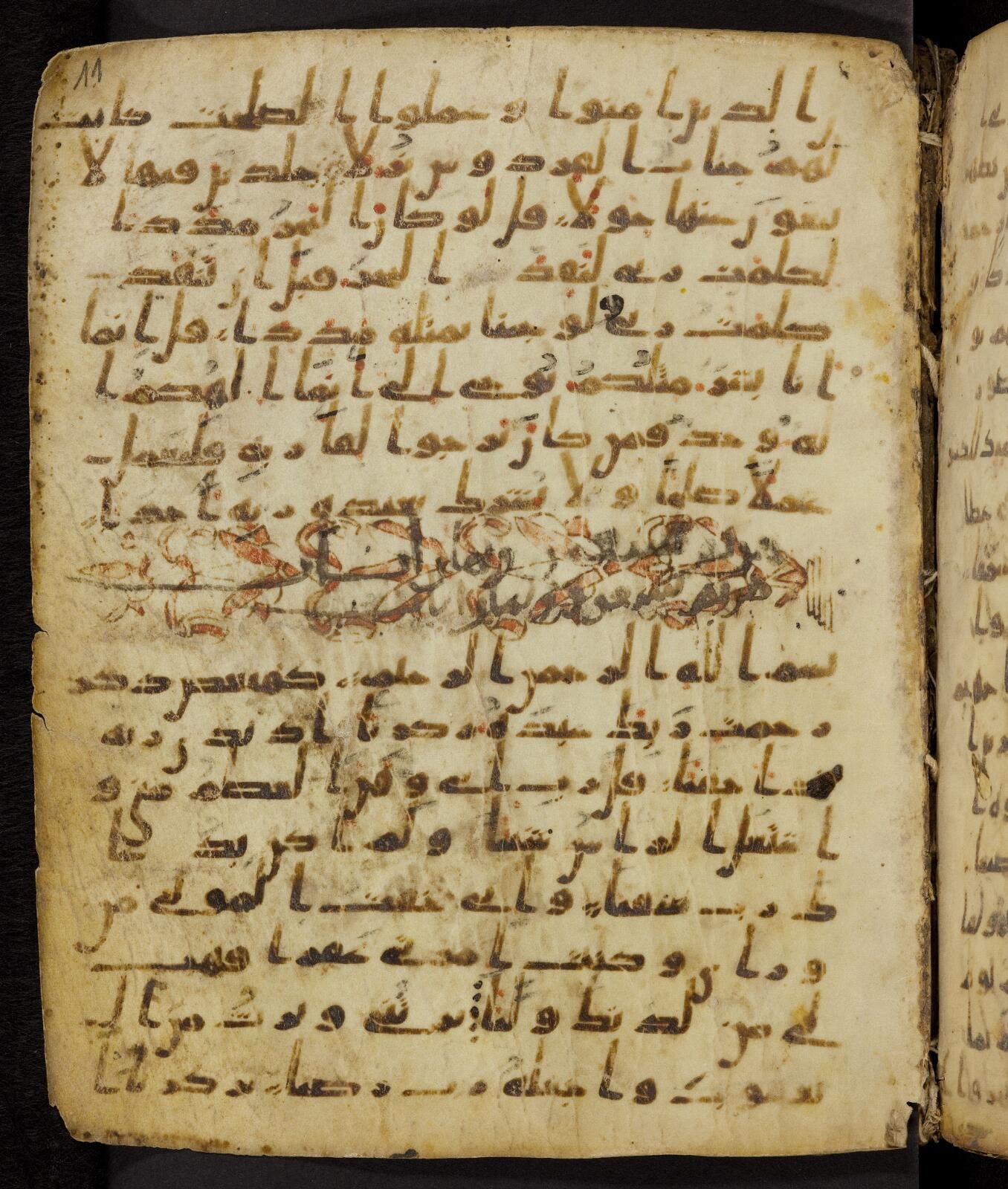
The Tubingen Quran codex, Ma VI 165, is a parchment book of 77 leaves held by Tubingen University Library, which lists its text as Quran 17:37 to 36:57. Radiocarbon dating of its animal skin gave 649 to 675 CE at 95.4 percent probability. Scholars disagree on whether the writing is as old as the skin. A digital copy is online.
Last reviewed:
Three dates, kept apart
The text's date: the tradition's view
610 to 650 CE (revelation 610 to 632 CE; the written standard text under Uthman about 650 CE, as David Thomas reports the Muslim account, and within Uthman's rule of 644 to 656 CE, which Abdullah Saeed gives as the time Muslim tradition holds the Quran was compiled; Yousef Wahb gives the 23 years of revelation, and Abu al-Qasim al-Khoei places the standard text under Uthman)
The text's date: critical scholars' view
610 to 705 CE (the strip starts at 610 CE, the date Muslim tradition gives for the first revelations, borrowed here because the scholarly sources used give no start year; it ends at the later of two views of the standard written text: Nicolai Sinai holds 650 CE or earlier as the default view, and Stephen Shoemaker argues for 685 to 705 CE, under Abd al-Malik, while allowing that much of the content may go back to Muhammad's preaching in the early seventh century)
This copy made
649 to 675 CE for the parchment (radiocarbon, ETH Zurich, 95.4 percent probability, three leaves merged); the range dates the animal skin, not the writing, and Stephen Shoemaker reports that experts had dated the writing to the early 8th century by script and format
This copy found
1864 (the earliest date in the sources used here: the library bought it with part of the collection of Johann Gottfried Wetzstein, a Prussian consul in Damascus, who bought it in Damascus; its earlier history is not recorded in the sources used here; the radiocarbon result was announced in November 2014)
What it is
The Tubingen codex is a book of 77 parchment leaves in Arabic. The library lists its text as the span from Quran 17:37 to 36:57, from verse 37 of surah (chapter) 17 to verse 57 of surah 36.123 The university describes the script as Kufic, one of the oldest forms of Arabic writing, in a very early variant called Hijazi. It notes that the pages are small beside other early copies.4 In Francois Deroche's system of classifying scripts it is Kufic B Ia.5
Michael Marx and Tobias Jocham, who report on the Coranica datings, write that the codex was changed with a different ink. They say the additions and corrections still need to be studied in depth, and that vowel signs were added later.5
How the copy was dated
A member of the Coranica project, a German and French study of early Quran manuscripts, took three samples of the parchment. The ion beam laboratory of ETH Zurich dated them by radiocarbon.4 The leaves numbered 23, 28, and 37 measured 1357, 1388, and 1319 years before present, each plus or minus 24. Merged, they give 649 to 675 CE at 95.4 percent probability.54 The range dates the animal skin, not the writing, and Marx and Jocham write that no scientific method yet dates inks that are not based on soot.5
Marx and Jocham hold that the radiocarbon date places the codex in the seventh century, though its script alone would suggest the eighth. They write that archaic spellings, such as that of the name Dawud (David), could indicate a high age. They report that radiocarbon dates of papyri and of three Syriac manuscripts matched other evidence. They find a long wait between making parchment and writing on it unlikely for economic reasons, while allowing that a workshop may have held parchment for some time.5
Stephen Shoemaker reports that experts had dated the codex by script and format to the early eighth century. He holds, with Alba Fedeli, that radiocarbon is often assumed to outrank other methods. He cites Deroche, who groups it with manuscripts made at the end of the seventh and the start of the eighth century under official patronage. He also holds that leaf 37 alone calibrates to 654 to 775 CE, so that merging the three leaves hides a later date.6
The university's release says the codex had been thought to date from the 8th or 9th century.4 Deroche himself writes that radiocarbon results should not be neglected but need to be taken cautiously, as Marx and Jocham quote him.5 For the methods, see how ancient texts are dated.
The text: its date and authorship
The date strip marks the Quran's text, not this codex. Both rows start at 610 CE, the year Muslim tradition gives for the first revelation.3 The scholars' row ends at the later of the two views below.
The tradition's view
Part of this column comes through reference works and scholars' reports (Saeed, Thomas). Abdullah Saeed writes that the standard traditional Muslim view, Sunni and Shia alike, holds that God alone composed the Quran. Muhammad passed it on without addition or alteration. Muslim tradition, he adds, holds that it was compiled in the caliphate of Uthman (ruled 644 to 656 CE).7 Yousef Wahb of the Yaqeen Institute writes that the Quran is God's speech. It was revealed over 23 years and kept in memory and writing, with memory the primary method.8
The Sunni hadith collection of al-Bukhari (hadith are reports of what Muhammad said or did) says the caliph Uthman had the earlier sheets copied. He sent a copy to each province.910
The Shia scholar Abu al-Qasim al-Khoei rejects the reports that caliphs collected the Quran, as contradicting one another. He holds that it existed as a complete written collection in Muhammad's lifetime and that Uthman united Muslims on one authoritative reading.1112 David Thomas reports Muslim tradition as dating the revelation to 610 to 632 CE and the written text to about 650 CE under Uthman, and writes that Muslims believe the Quran they read today is the text standardised under him.3
Scholars of the Quran's history: Sinai and Shoemaker
Nicolai Sinai, in a 2014 article, describes 650 CE or earlier as the traditional dating of the standard consonantal text, the letters without vowel signs. He holds that this ought to be the default view, apart from some spelling features, as long as no passages with a distinct style and vocabulary have been convincingly placed in the late seventh century. He writes that in recent years various scholars have espoused a conjectural dating of the text's codification to Abd al-Malik's time, or have at least held that it stayed open to significant revision until about 700 CE.13
Shoemaker, in a book of 2022, writes that most modern scholarship has accepted that Uthman fixed the text around 650 CE, and he calls that confidence undeserved.6 He argues that the canonical text took shape under the caliph Abd al-Malik (ruled 685 to 705 CE), and writes that much of the content may ultimately go back to Muhammad's preaching in the early seventh century.6 He holds that, for now, radiocarbon should not be relied on for ranges of less than a century or two.6 The passages cited here study when the text was fixed and do not address what Muslims hold about its authorship.
How it was found
The university's release says the library bought the codex in 1864, when it acquired part of the collection of Johann Gottfried Wetzstein, a Prussian consul in Damascus.4 Marx and Jocham write that Wetzstein bought it in Damascus.5 Max Weisweiler described it in his 1930 catalogue of the library's Arabic manuscripts.4
The sources used here do not say where the codex was made, who wrote it, or what became of it before Wetzstein. A Coranica member took the radiocarbon samples with the library's permission, and the university announced the result in November 2014.45
What it shows, and what it does not
The evidence shows a merged radiocarbon range of 649 to 675 CE, at 95.4 percent probability, for the animal skins of three leaves. On the library's record, it shows a text from 17:37 to 36:57 in an early script. It shows that the codex was corrected and given vowel signs.5 The library has put it online and says that, to the best of its knowledge, the work is free of known copyright.2
It does not show when the text was written, by whom, or where. The merged range and the youngest single leaf give different pictures, and scholars weigh script and spelling against radiocarbon differently. Whether leaves of different ages were bound into one codex is also debated.56
See also
Read next
Sources
- Marijn van Putten. The Grace of God as Evidence for a Written Uthmanic Archetype: The Importance of Shared Orthographic Idiosyncrasies. Bulletin of the School of Oriental and African Studies 82, no. 2 (2019), 2019, the list of manuscripts examined, entry T. Accessed 2026-11-06.
- Tubingen University Library. Kufisches Koranfragment, Sure 17,37-36,57 (Ma VI 165), digital edition. Tubingen University Library (OpenDigi), the record page. Accessed 2026-11-06.
- University of Birmingham. Birmingham Qur'an manuscript dated among the oldest in the world. University of Birmingham, 2015. Accessed 2026-10-29.
- Universitat Tubingen (press office). Raritat entdeckt: Koranhandschrift stammt aus der Fruhzeit des Islam (press release, in German). University of Tubingen, 2014, the whole release. Accessed 2026-11-06.
- Michael Josef Marx and Tobias J. Jocham. Radiocarbon (14C) Dating of Qur'an Manuscripts. In Andreas Kaplony and Michael Marx (eds.), Qur'an Quotations Preserved on Papyrus Documents, 7th to 10th Centuries (Brill, Leiden, 2019), chapter 6, pp. 188 to 221, 2019, pp. 188 to 217; the table on p. 216; the Dawud spelling on pp. 207 to 209. Accessed 2026-11-06.
- Stephen J. Shoemaker. Creating the Qur'an: A Historical-Critical Study. University of California Press (Luminos open access), 2022, introduction (radiocarbon summary; Abd al-Malik, p. 13; pp. 3 and 14 to 15), chapter 1 (p. 17 and pp. 25 to 30), chapter 2 (p. 43), the radiocarbon chapter (pp. 73 to 86), and p. 238 (printed page numbers). Accessed 2026-10-29.
- Abdullah Saeed. Qur'an: Tradition of Scholarship and Interpretation. Encyclopedia of Religion, second edition (Macmillan Reference USA), via Encyclopedia.com, 2005. Accessed 2026-10-29.
- Yousef Wahb. How the Quran Was Preserved During the Prophet's Time: Mechanisms of Oral and Written Transmission. Yaqeen Institute for Islamic Research, 2022. Accessed 2026-10-28.
- Muhammad al-Bukhari (compiler). Sahih al-Bukhari 4987, English translation. Hadith Unlocked, hadith 4987. Accessed 2026-10-29.
- Mohammad Hashim Kamali. Hadith. Encyclopedia of Religion, second edition (Macmillan Reference USA), via Encyclopedia.com, 2005. Accessed 2026-10-29.
- Abu al-Qasim al-Khoei, translated by Abdulaziz A. Sachedina. The Prolegomena to the Qur'an, chapter 8: The Collection of the Qur'an. Oxford University Press (1998); online at Al-Islam.org, 1998, chapter 8. Accessed 2026-10-29.
- Al-Islam.org (Ahlul Bayt Digital Islamic Library Project). Sayyid Abu al-Qasim al-Khoei (biographical page, Shia Scholars). Al-Islam.org, the biography paragraph on the person page. Accessed 2026-11-06.
- Nicolai Sinai. When did the consonantal skeleton of the Quran reach closure? Part II. Bulletin of the School of Oriental and African Studies 77, no. 3, 2014, abstract. Accessed 2026-10-29.