
Writings: Hinduism
The Paippalada codex at Tubingen
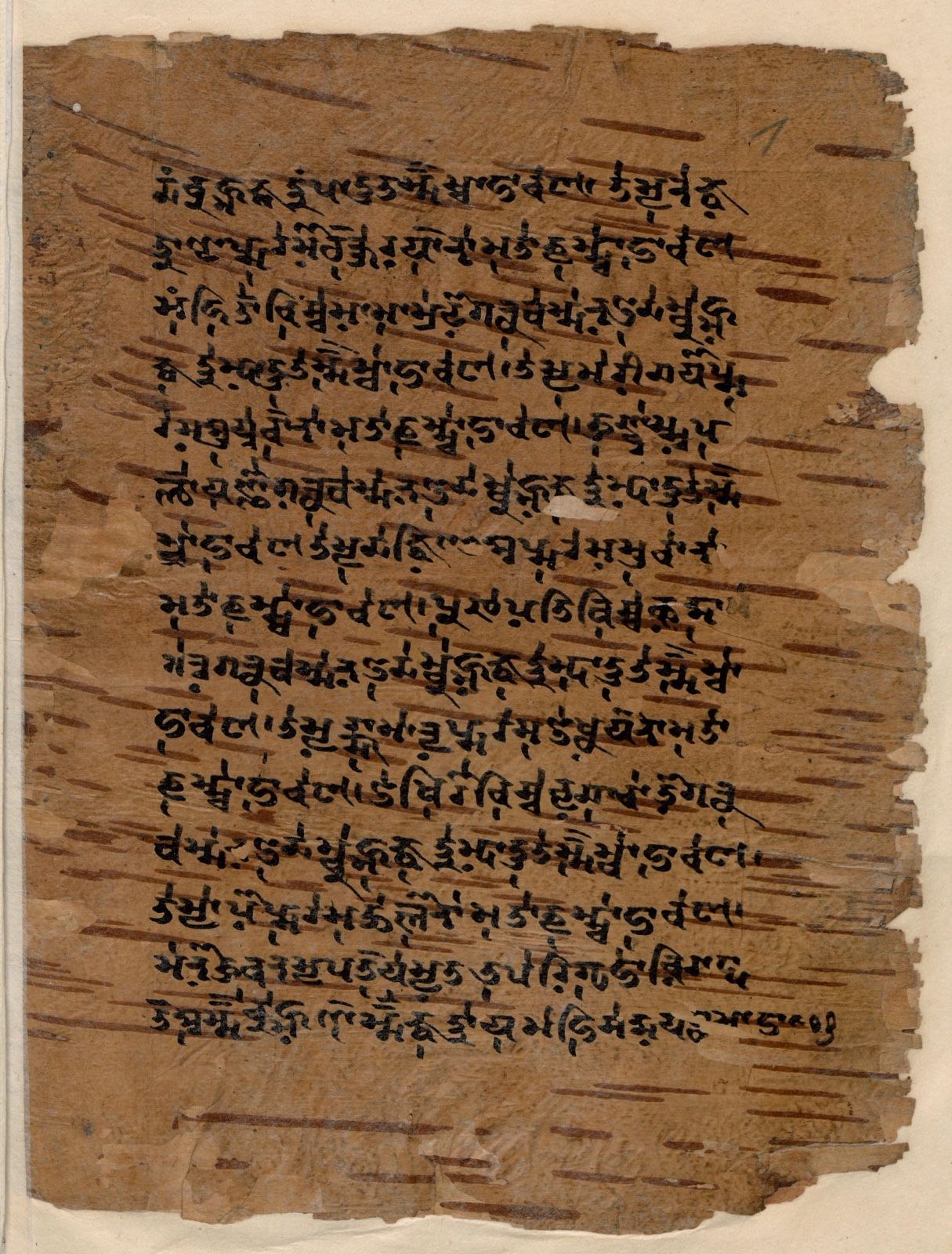
This is a birch-bark book from Kashmir holding the Paippalada version of the Atharvaveda, the fourth Veda. It reached Tubingen, Germany, on loan in 1876 and stayed. Scholars date it to 1419 CE or about 1550 CE. Outside scholars knew only this copy until the late 1950s, though the school's tradition was still alive in Odisha.
Last reviewed:
Three dates, kept apart
The text's date: the tradition's view
No date for the Paippalada Samhita: none of the statements used here gives one, and none from Paippalada brahmans themselves was found. Dancing with Siva, the catechism of a monistic Shaiva Siddhanta lineage, says the four Vedas as a whole date back 6,000 to 8,000 years (about 6000 to 4000 BCE, computed here from 2026), and ISKCON Educational Services, a Vaishnava source, reports that tradition often dates the Vedas to about 3000 BCE.
The text's date: critical scholars' view
about 1500 to 500 BCE for the Vedic corpus, of which the Atharvaveda is a part (Umberto Selva). Alf Hiltebeitel gives about 1400 to 400 BCE for the Vedic literature
This copy made
1419 or about 1550 CE (two datings; the year in the colophon as calculated, or a copy of an older exemplar judged from the script)
This copy found
1873 to 1876 (a copy made in 1873 for Rudolph Roth of Tubingen from the manuscript in the library of Ranbir Singh, maharaja of Jammu and Kashmir, at Srinagar; the original loaned to Roth in 1876)
What it is
The Atharvaveda is the fourth Veda, a collection of hymns, mantras, and incantations.12 Umberto Selva ranks it second only to the Rigveda in importance, extent, and antiquity, and describes it as mainly healing charms, spells, and prayers for household rites.3 Of its many ancient versions, called recensions, only two survive, the Shaunaka and the Paippalada.3
This codex, a book of birch-bark leaves, holds the Paippalada Samhita (a samhita is a collection of verses) in Sanskrit, written in Sharada, a script used mainly in Kashmir.4 Its 1901 editors counted about 275 leaves, written on both sides, with the first leaf lost.4 Selva calls the text extremely corrupt, meaning full of errors that left much of it hard to read.3
How the copy was dated
The codex has a note by its scribe, called a colophon, on folio 287b of the facsimile, which Walter Slaje restores where the bark has peeled. It names the scribe, Prasastabhava, and the Ahalya Matha, a college in Srinagar. It gives the year as 95, in what Slaje takes to be the local Kashmiri era, with a Friday, the thirteenth lunar day, and the month of Margashirsha.5
Slaje, and Arlo Griffiths in his prefatory remarks to the volume, treat 1419 CE as the date of copying this manuscript or its exemplar, the copy it was made from. They rest it on the colophon: Claus Vogel and Michael Witzel calculated that its year, month, lunar day, and weekday fit Friday, 15 December 1419. Slaje kept that date despite doubts about how the colophon reads and which calendar the scribe used. He ruled out the other fit, 6 December 1219, because the Ahalya Matha was founded between 1273 and 1286. He adds that it is unclear whether the codex is the original or a copy.55
Umberto Selva reports that the codex itself has been dated to the mid 16th century CE, citing Slaje and a summary by Carlos Lopez (2010), which this site could not open. The Slaje pages read here give 1419 for the colophon and no 16th-century date for the codex. On Selva's account, Witzel argued in 1985, from the script, that the colophon's date was most likely copied from an exemplar in an older form of Sharada. On that view the codex dates from about 1550. This site could not open Witzel's article either.3
The library's catalog also says 16th century, and the 1901 editors said about 400 years old. The sources used here give no reasons for either judgment.64 For the methods, see how ancient texts are dated.
The text: its date and authorship
The date strip marks the Paippalada Samhita of the Atharvaveda, not this codex.
Hindu sources
Two Sanskrit lists, the Atharvavedaparishishta and the Caranavyuha, name nine schools of the Atharvaveda and put the Paippalada first, as Selva reports.3 Dancing with Siva is the catechism of a monistic Shaiva Siddhanta lineage, which teaches that the soul and God are in the end perfectly one.78 It holds that God revealed the four Vedas through rishis, or seers, and that they date back 6,000 to 8,000 years.910
ISKCON Educational Services, a Vaishnava source (Vaishnavas worship Vishnu and his incarnations, especially Krishna and Rama),21112 reports that tradition often dates the Vedas to around 3000 BCE.2 None of these gives the Paippalada school a separate date, and none from Paippalada brahmans was found.
The historians' view
Alf Hiltebeitel, in the Encyclopedia of Religion, dates the Vedic literature to about 1400 to 400 BCE and describes it as originally oral. He holds that the four collections were probably complete by 1000 BCE.1 Umberto Selva places the Atharvaveda in the Vedic corpus of about 1500 to 500 BCE.3 He reports that the Paippalada was probably more widespread, prominent, and influential in the past. He adds that Witzel's hypothesis of a Gujarat home for the school in early medieval times is still the most widely accepted.3 The sources used here give no separate date or author for the Paippalada Samhita.
How it was found
Rudolph Roth of Tubingen urged the British government of India to seek manuscripts in Kashmir, where brahmans, or priests, were said to belong to the Atharvaveda. Ranbir Singh, the maharaja (ruler) of Jammu and Kashmir, announced that his library in Srinagar held a manuscript that no one outside Srinagar could read.34 A copy in Devanagari script was made for Roth in 1873, and the Government of India loaned him the original in 1876.34
It stayed in Tubingen, and after Roth died in 1895 it passed into the University Library's possession, as the 1901 editors put it. The sources used here do not say how the loan ended.34 Maurice Bloomfield and Richard Garbe published a photographic facsimile in 1901.4
What it shows, and what it does not
The codex shows that one Vedic school's text was copied in Kashmir by the 15th or 16th century. For scholars outside the school it was the only known copy until the late 1950s. Then Durgamohan Bhattacharyya learned of Paippalada brahmans in Odisha and retrieved palm-leaf manuscripts in their possession, which in Selva's words preserved a significantly better version of the text than the Kashmir copy. Selva reports that the tradition was still alive in Odisha then and, as of 2019, in parts of Jharkhand. On Witzel's reconstruction, the extant Odisha manuscripts (17th to 20th century) descend from a lost copy of about 1400 CE separate from the Kashmir line.3
It does not show when the Paippalada hymns were composed. The codex is about 1,800 to 3,050 years later than the historians' spans above and about 4,400 to 7,500 years later than the tradition's figures that carry years, computed here. It does not settle between 1419 and about 1550. Witzel argues that the surviving manuscripts go back to a written archetype, or common ancestor, made in Gujarat about the 9th century CE, or about 800 to 1000 CE in a 2000 post. That dates the writing, not the hymns, and none of the sources used here reports a manuscript of it.313
Read next
Sources
- Alf Hiltebeitel. Hinduism. Encyclopedia of Religion, second edition (Macmillan Reference USA), via Encyclopedia.com, 2005. Accessed 2026-10-29.
- ISKCON Educational Services. Heart of Hinduism: Shruti: The Four Vedas. ISKCON Educational Services. Accessed 2026-10-29.
- Umberto Selva. The Study of the Paippalada Recension of the Atharvaveda: The State of the Art. Kervan: International Journal of Afro-Asiatic Studies, no. 23, special issue (2019), pp. 199 to 234, University of Turin, 2019, pp. 199 to 203 and 211, with footnotes 2, 3, 10, 12, and 16. Accessed 2026-11-06.
- Maurice Bloomfield and Richard Garbe. The Kashmirian Atharva-Veda (School of the Paippaladas), reproduced by chromophotography from the manuscript in the University Library at Tubingen, part 1: plates 1 to 180 (preface). Johns Hopkins Press, Baltimore, 1901, preface, pp. i to iii. Accessed 2026-11-06.
- Walter Slaje (with prefatory remarks by Arlo Griffiths, one of the volume's two editors). Three Bhattas, Two Sultans, and the Kashmirian Atharvaveda. In Arlo Griffiths and Annette Schmiedchen (eds.), The Atharvaveda and its Paippaladasakha: Historical and Philological Papers on a Vedic Tradition (Shaker Verlag, Aachen, 2007), pp. 329 to 353; the author's offprint, which he posted to the INDOLOGY list on 10 February 2014, 2007, paper pp. 2 to 3 (volume pp. 330 to 331) and the discussion and postscript, pp. 16 to 20 (volume pp. 344 to 348); Griffiths's prefatory remarks, p. ii. Accessed 2026-11-06.
- Universitatsbibliothek Tubingen (Tubingen University Library). Atharvaveda, Paippaladasakha, Teil 1 to Teil 8 (shelfmarks Ma I 421-1 to Ma I 421-8): Handschrift auf Birkenrinde in Saradaschrift. OpenDigi, Tubingen University Library, the record for part 1; parts 2 to 8 read at the same address with the last digit changed. Accessed 2026-11-06.
- Sivaya Subramuniyaswami. Dancing with Siva: What Is the Source of This Catechism?. Himalayan Academy, 2003. Accessed 2026-10-29.
- Sivaya Subramuniyaswami. Dancing with Siva: Hinduism's Contemporary Catechism, sixth edition: Sloka 148, What Are the Views on God and Soul?. Himalayan Academy (web edition), 2003, Sloka 148, What Are the Views on God and Soul?. Accessed 2026-10-29.
- Sivaya Subramuniyaswami. Dancing with Siva: What Are Hindu Revealed Scriptures?. Himalayan Academy, 2003. Accessed 2026-10-29.
- Sivaya Subramuniyaswami. Dancing with Siva: What Is the Nature of the Veda Texts?. Himalayan Academy, 2003. Accessed 2026-10-29.
- Michael Witzel. Dates of written Rgveda (post to the INDOLOGY mailing list). INDOLOGY list archive (list.indology.info), 2000, the whole post (March 2000). Accessed 2026-11-06.